all

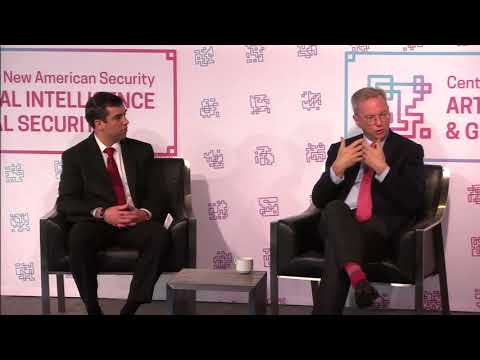
Eric Schmidt (Google) (March 25, 2021)

Dr. Eric Schmidt emphasizes the urgent need for a comprehensive U.S. strategy on technological advancements, particularly in AI, 5G, and national security, to maintain global competitiveness primarily against China. He advocates for collaboration among government, industry, and academia, while also addressing ethical considerations and the broader societal and geopolitical implications of technology.

Eric Schmidt (Google) (March 25, 2021) Read More »

Drew Houston (Dropbox) (Feb 2017)

Drew Houston, co-founder and CEO of Dropbox, shares insights into the entrepreneurial process, from the initial idea sparked by a personal inconvenience to the complexities of scaling a tech startup and evolving leadership roles. His advice spans diverse topics including decision-making, coping with negativity, the importance of adaptability, and the need for a diverse board for effective governance.

Drew Houston (Dropbox) (Feb 2017) Read More »

Ed Catmull (Pixar) & Larry Ellison (oracle) (May 2012)

The conference on Steve Jobs reveals him as a multi-dimensional figure whose success is attributed to his evolving leadership styles, attention to detail, and ability to turn innovative ideas into marketable products. His lasting impact on tech leadership and unconventional approach to business challenges simplistic narratives, offering both inspiration and cautionary lessons for emerging tech leaders.

Ed Catmull (Pixar) & Larry Ellison (oracle) (May 2012) Read More »

Eric Schmidt (Alphabet) (March 2023)

Eric Schmidt, former CEO of Google, discusses the transformative potential of Artificial Intelligence (AI) in various sectors like education and healthcare, while also cautioning against ethical and societal risks such as the “alignment problem” and erosion of truth in public discourse. He advocates for interdisciplinary collective action to address these challenges, and highlights the importance of government understanding, the role of AI in scientific discovery, and the tension between open-source and proprietary systems.

Eric Schmidt (Alphabet) (March 2023) Read More »

Barack Obama (USA) (September 25, 2015)

In a comprehensive meeting between President Obama and Chinese President Xi, the leaders discussed a wide range of topics including economic interdependence, cybersecurity, climate change, and human rights. The dialogue revealed a complex U.S.-China relationship characterized by both cooperation on shared global responsibilities and challenges arising from divergent political ideologies and security concerns.

Barack Obama (USA) (September 25, 2015) Read More »

Barack Obama (USA) (Nov 12, 2014)

Recent state visits between the U.S. and China have established avenues for cooperation in economics, military relations, and climate change, while also addressing ongoing challenges like geopolitical concerns and human rights. Both nations express a commitment to diplomacy and direct dialogue as mechanisms to navigate the complexities inherent in their relationship, recognizing its broader significance for global stability.

Barack Obama (USA) (Nov 12, 2014) Read More »

Jack Ma (Alibaba) and Elon Musk (Tesla, SpaceX, Etc.) (August 29, 2019)

Elon Musk and Jack Ma present contrasting views on AI and human progress: Musk emphasizes the risks of underestimating AI and advocates for Neuralink as a step towards AI-human integration, while Ma is optimistic about AI’s potential to enhance human understanding and growth. They both agree on the need for education reform but differ on existential risks, with Musk advocating for multi-planetary civilization and Ma focusing on Earth’s sustainability.

Jack Ma (Alibaba) and Elon Musk (Tesla, SpaceX, Etc.) (August 29, 2019) Read More »

Eric Schmidt (Alphabet) (November 1, 2017)

Eric Schmidt, Alphabet’s veteran leader, emphasizes the critical role of Artificial Intelligence (AI) in shaping competitive advantages in business and military sectors, while also highlighting the U.S.’s lack of a coherent national AI strategy in contrast to China’s ambition to dominate AI by 2030. He identifies talent acquisition, data availability, and a shift towards a culture of innovation as key drivers for AI adoption, and urges immediate focus on cybersecurity, public-private partnerships, and reassessment of governance structures.

Eric Schmidt (Alphabet) (November 1, 2017) Read More »

Elon Musk (Twitter) (April 18, 2023)

Elon Musk’s vision for Twitter emphasizes a balanced approach that prioritizes “unregretted user time,” free speech with limitations on artificial reach, and increased transparency through open-sourcing algorithms. He also introduces features for advertiser control and community-driven self-regulation, aiming for Twitter to be a commercially viable, trusted, and democratically open platform.

Elon Musk (Twitter) (April 18, 2023) Read More »